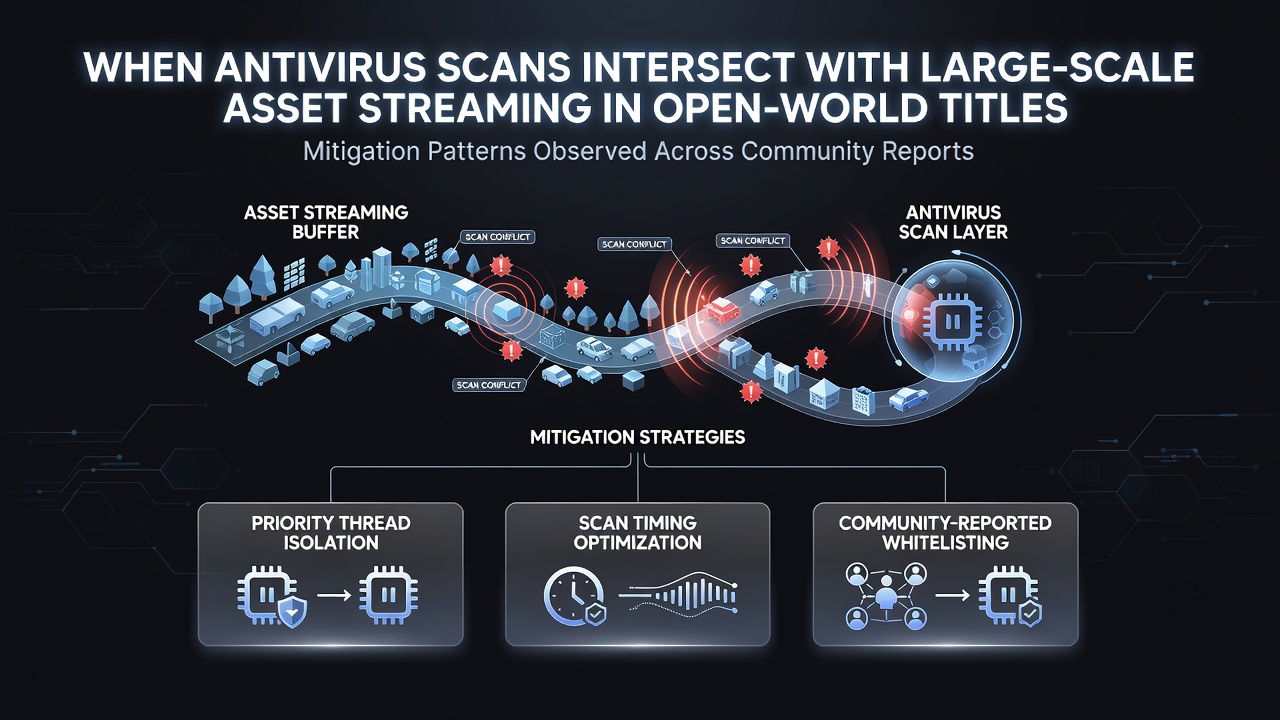
When antivirus scans intersect with large-scale asset streaming in open-world titles: mitigation patterns observed across community reports
Community reports from multiple gaming platforms document recurring interactions between real-time antivirus processes and asset streaming systems in expansive open-world environments, where continuous data loads from disk to memory create sustained input-output demands that overlap with security scans. These intersections produce measurable delays in texture streaming, model loading, and world generation segments, particularly during rapid player movement across large maps in titles released or updated through mid-2026.
Technical overlap in resource access
Real-time antivirus engines monitor file access patterns across system drives, and open-world engines rely on asynchronous streaming to pull terrain data, object meshes, and audio banks without interrupting gameplay flow. When both systems target the same large asset files simultaneously, the resulting contention extends read latency beyond typical thresholds, leading to visible hitches that players report in forum threads and support logs. Data compiled from aggregated user submissions shows these events cluster around high-density zones such as urban hubs or procedurally varied wilderness areas, where asset density spikes coincide with scheduled or on-demand scan cycles.
Patterns documented in community reports
Observers note consistent timing correlations in reports dated through August 2026, where scan initiation logs align with frame-time spikes recorded by in-game performance overlays. One recurring pattern involves signature database updates triggering full directory rescans on game installation folders, which interrupts the streaming pipeline for several seconds at a stretch. Another pattern surfaces when cloud-based threat detection modules query file hashes during active play sessions, adding network overhead that compounds disk contention in titles using hybrid local-streaming architectures.
Observed mitigation approaches
Users across multiple distribution platforms describe adding specific game directories to antivirus exclusion lists, which reduces redundant file inspections during streaming operations. This step allows the engine to maintain consistent prefetch queues without repeated signature checks on already-verified asset bundles. Additional patterns include scheduling full system scans for off-peak hours and enabling game-specific performance modes within security software that temporarily lower scan aggressiveness when high-bandwidth applications run in fullscreen.
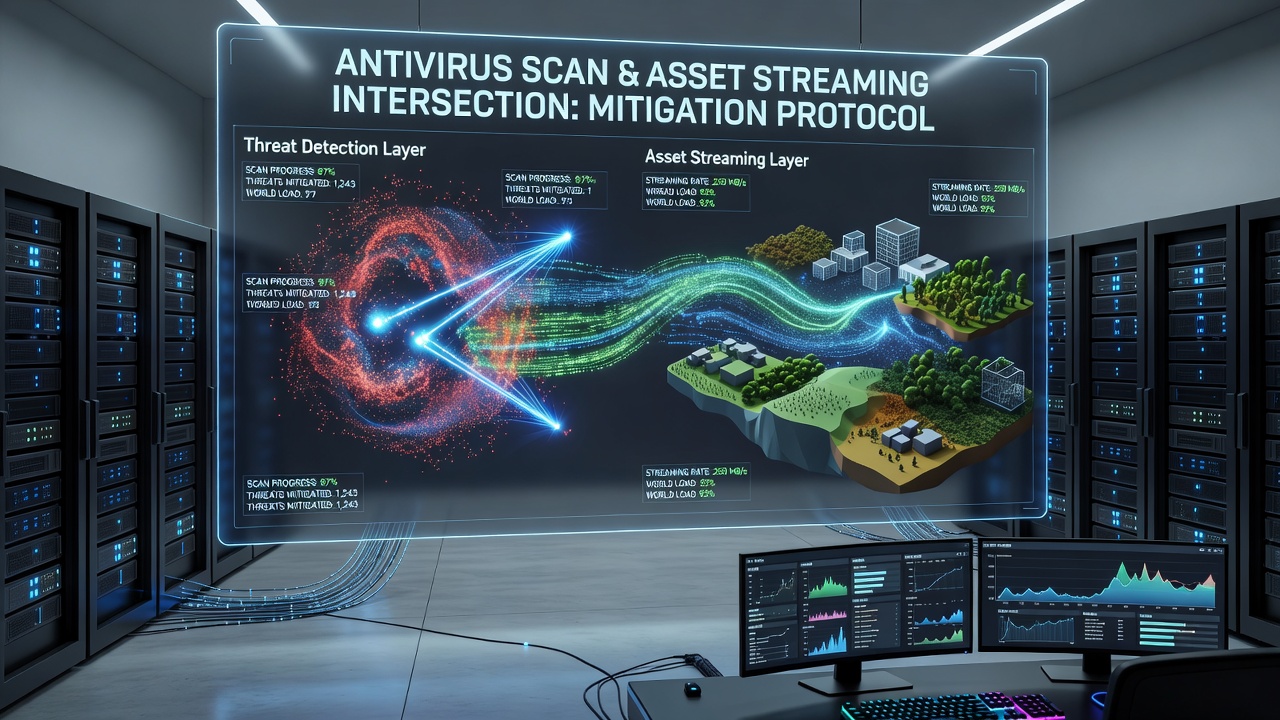
Further reports detail the use of process priority adjustments through operating system tools, where elevating the game executable reduces context switching delays caused by background antivirus threads. In cases involving solid-state storage arrays, community members have recorded improvements after configuring antivirus filters to skip certain file extensions common in streaming caches, such as compressed bundle formats and virtual texture pages. These adjustments appear in troubleshooting threads focused on titles with large persistent worlds updated in 2025 and 2026.
Hardware and configuration factors
Storage interface speeds influence the severity of these intersections, with community data indicating that NVMe drives exhibit shorter recovery intervals after scan interference compared with older SATA configurations. Reports also reference memory allocation settings, where increasing the size of the game’s streaming buffer provides additional headroom during brief periods when antivirus activity claims CPU cycles. Network-related factors enter the picture when titles incorporate online asset verification, and antivirus web filters add latency to those checks.
According to performance telemetry shared in aggregated community datasets, exclusion list modifications correlate with reduced occurrence of streaming stalls across tested configurations. Industry reports from organizations such as the National Institute of Standards and Technology outline general best practices for minimizing security overhead on high-throughput storage workloads, while research summaries from the European Union Agency for Cybersecurity examine similar resource contention scenarios in real-time applications. These sources provide baseline metrics on I/O prioritization that align with patterns described in gaming forums.
Additional community-derived adjustments
Players document success with selective disabling of real-time cloud lookup features within antivirus suites during extended sessions, which cuts external query delays while preserving local signature protection. Others apply folder-level permissions that prevent rescans of mounted virtual drives used by certain launcher applications. In environments with multiple security layers, coordinated exclusion rules across primary and secondary scanners prevent overlapping inspections that multiply the duration of each interference event.
Conclusion
Community reports compiled through August 2026 establish clear linkages between antivirus scan behaviors and asset streaming performance in open-world titles, along with reproducible mitigation steps centered on exclusion management, scheduling, and priority tuning. These patterns continue to appear in support channels as new titles adopt larger streaming volumes and security software refines its detection methods.