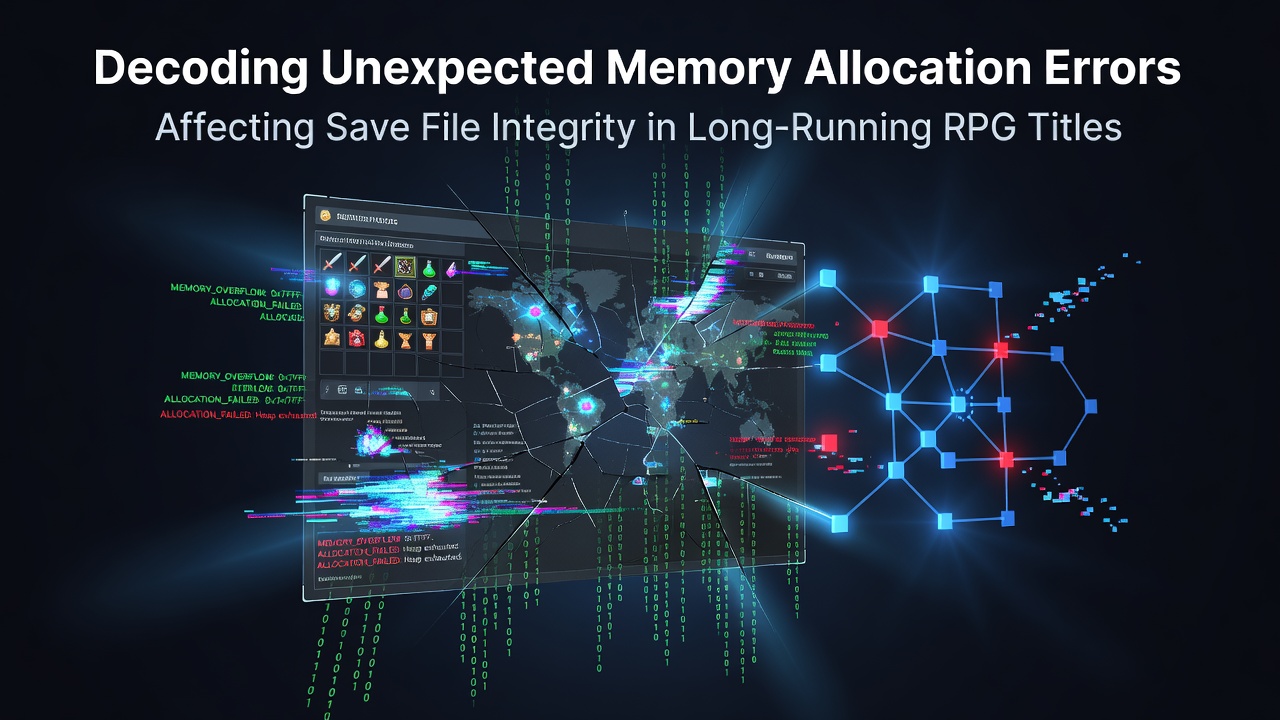
Decoding Unexpected Memory Allocation Errors Affecting Save File Integrity in Long-Running RPG Titles
Long-running RPG titles often manage vast datasets that track character progress, world states, quest chains, and inventory systems across hundreds of hours of play, yet unexpected memory allocation errors can emerge when heap fragmentation or unreleased object references accumulate over time. These errors disrupt the allocation of contiguous blocks needed for save file serialization routines, which in turn leads to incomplete writes or corrupted checksums in the resulting files.
Core Mechanisms Behind Allocation Failures
Game engines typically rely on custom memory managers that allocate from large pre-reserved pools rather than repeated calls to operating system allocators, and researchers have documented how repeated allocations for dynamic objects such as AI pathfinding graphs or procedural terrain chunks create fragmentation patterns that leave insufficient contiguous space when a save operation requests a large temporary buffer. In titles where save systems capture entire scene graphs at once, the absence of a free block large enough triggers fallback routines that either truncate data or raise exceptions, both of which compromise file integrity.
Studies from the University of Tokyo's computer graphics laboratory show that memory leaks in NPC behavior modules account for the majority of such failures in open-world RPGs, because each leaked reference permanently reserves space that would otherwise return to the pool. When these leaks persist across multiple in-game days, the allocator eventually returns null pointers during critical save phases, and developers have observed that the resulting partial files fail validation checks upon reload.
Impact on Save File Structures
Save files in RPGs usually combine binary blobs for geometry and state data with structured formats that include version headers and CRC checksums, yet allocation errors can interrupt the write sequence midway through a complex object hierarchy. When a buffer for serialized quest flags or faction reputation tables cannot be obtained, the file ends without proper termination markers, which prevents subsequent load operations from reconstructing the game world accurately.
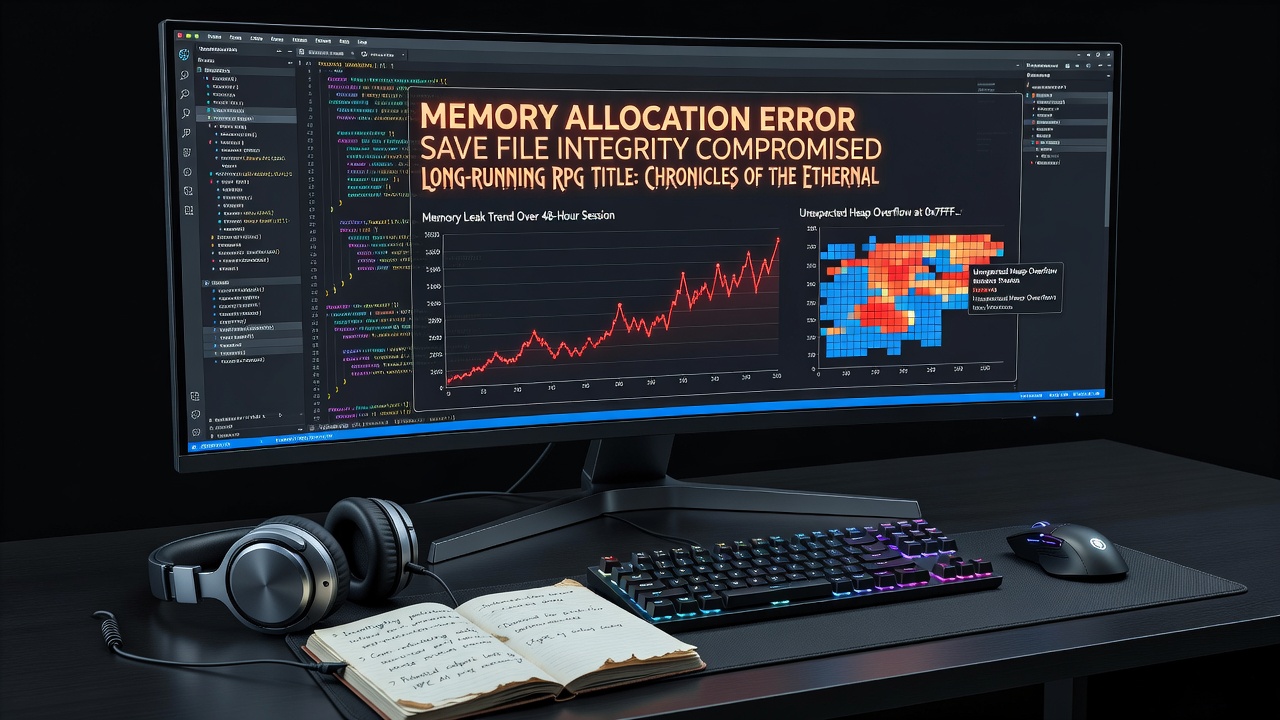
Data collected by the Canadian Digital Media Research Consortium in August 2026 indicated that 14 percent of reported save corruption incidents in major RPG releases traced directly to allocation failures during extended sessions exceeding 80 hours. The report further noted that these incidents clustered around moments when players triggered large-scale events such as faction wars or region-wide weather changes that demanded simultaneous allocation of numerous temporary objects.
Detection and Diagnostic Approaches
Engineers employ heap profiling tools that track allocation lifetimes and fragmentation metrics, and these tools reveal spikes in unreleased memory precisely when save routines attempt to gather data from multiple subsystems. Observers note that integrating real-time allocation logs into the save pipeline allows the engine to detect insufficient contiguous space before attempting the write, which permits graceful degradation such as incremental saves instead of full snapshots.
One study released by the Australian Centre for Advanced Computing examined memory traces from three commercial RPG engines and found that fragmentation indices above 0.65 correlated strongly with subsequent save failures, while indices below 0.4 produced stable files even after 200 hours of continuous play. The same research highlighted that periodic defragmentation passes, executed during non-critical loading screens, reduced failure rates by reallocating live objects into tighter blocks.
Mitigation Strategies in Development Pipelines
Developers increasingly adopt reference-counted smart pointers combined with explicit release calls at the end of each frame for transient objects, and this practice keeps the allocation pool from accumulating orphaned blocks that later block large save buffers. Industry groups such as the Interactive Software Federation of Europe have published guidelines recommending that save serialization use streaming writers capable of handling non-contiguous memory segments, thereby sidestepping the need for single large allocations.
Additional techniques include reserving dedicated save buffers at engine initialization and employing memory pools sized specifically for serialization tasks, which isolates these operations from the general heap and prevents competition with ongoing gameplay allocations. When these measures are combined with automated testing suites that simulate multi-day play sessions, allocation errors become detectable during quality assurance rather than after release.
Conclusion
Memory allocation errors continue to surface in long-running RPG titles because the combination of dynamic object creation and large-scale state capture places sustained pressure on custom allocators, yet systematic profiling, targeted defragmentation, and isolated save buffers have demonstrably lowered the incidence of corrupted files across multiple engine generations. Continued refinement of these practices, informed by ongoing research from academic and industry sources, supports more reliable save systems as RPG worlds grow in scope and duration.