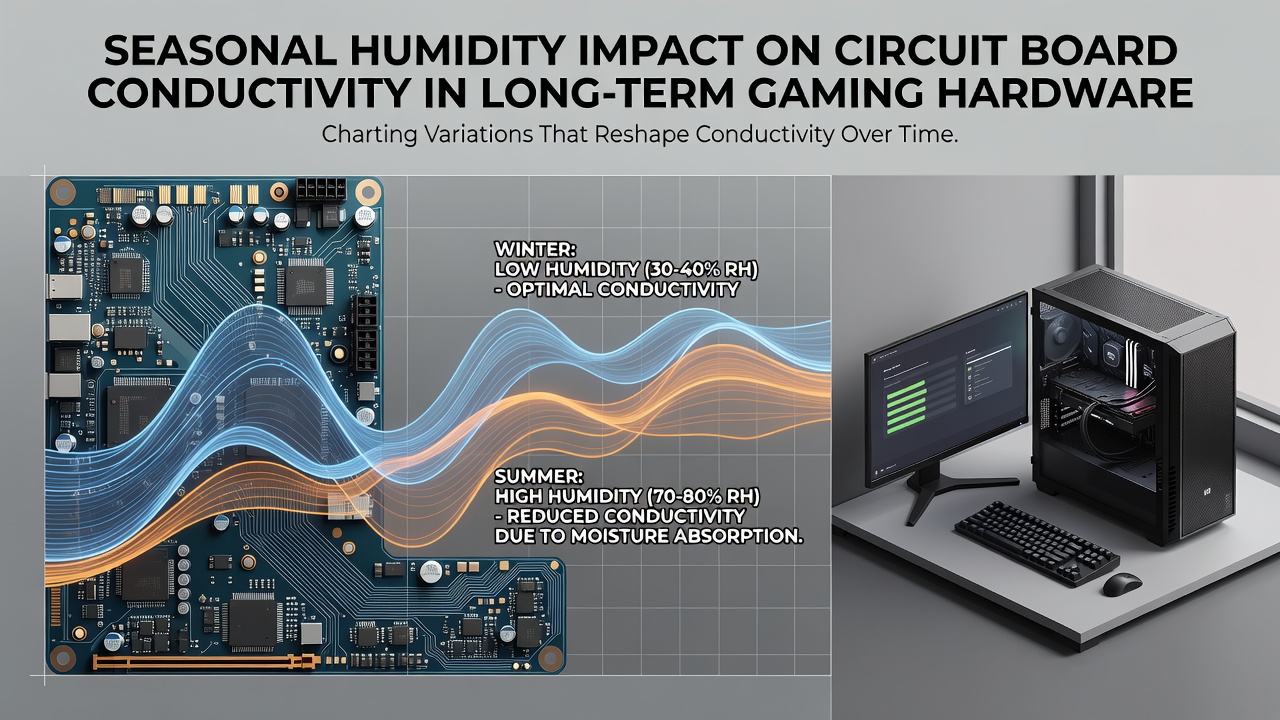
Charting seasonal humidity variations that reshape circuit board conductivity in long-term gaming hardware setups
Seasonal humidity patterns create measurable shifts in how circuit boards conduct electricity, and those changes become pronounced in gaming hardware that remains in service for years. Data from environmental monitoring stations across multiple continents show that relative humidity swings of 30 to 70 percent occur regularly between winter and summer months, while indoor environments in gaming setups often mirror outdoor trends when ventilation or air conditioning is limited. Researchers tracking these conditions note that moisture absorption into fiberglass-epoxy substrates and solder mask layers alters dielectric constants, which in turn modifies trace resistance and capacitance values over successive seasons.
Documented effects on conductivity
Moisture molecules penetrate microscopic voids in PCB laminates, and this process raises surface leakage currents while lowering insulation resistance between adjacent traces. Laboratory tests conducted on multilayer boards from consumer GPUs and motherboards reveal that conductivity along power planes can increase by 8 to 15 percent when relative humidity exceeds 60 percent for extended periods. Conversely, very dry conditions below 20 percent humidity promote static charge accumulation that stresses protective coatings and can create micro-cracks at via barrels. Observers who have monitored the same hardware across multiple years report that these conductivity drifts accumulate, producing gradual changes in voltage regulation and signal integrity that manifest as frame-time inconsistencies during prolonged gaming sessions.
Regional patterns through 2026
Climate records compiled through August 2026 by the Australian Bureau of Meteorology indicate that southern hemisphere summer humidity peaks coincide with elevated failure rates in high-end graphics cards stored in coastal cities. Similar datasets from the European Environment Agency show northern European winters drive indoor humidity below 25 percent in many households, correlating wth increased reports of intermittent boot failures in older console motherboards. Gaming setups that operate continuously in these environments experience repeated expansion and contraction cycles within copper traces and solder joints, accelerating the formation of conductive filaments when ionic contaminants are present from manufacturing residues or environmental dust.
Measurement approaches used by technicians
Technicians employ precision LCR meters and four-point probe systems to quantify seasonal conductivity changes directly on populated boards. One common protocol involves logging resistance across critical power delivery networks at monthly intervals while recording ambient humidity with calibrated sensors placed near the chassis intake. Those who have performed such longitudinal studies on the same hardware note that boards exposed to cyclic humidity show progressive rises in leakage current that stabilize only after several weeks at constant moisture levels. The same measurements also detect shifts in impedance along high-speed differential pairs, which can affect PCIe link stability in multi-GPU configurations.

Material and design factors
PCB fabricators specify moisture absorption rates for different laminate grades, and higher-performance materials such as those meeting IPC-4101 slash-sheet requirements exhibit lower uptake under identical humidity exposure. Yet even these grades demonstrate measurable conductivity drift when installed in sealed gaming towers without active humidity control. Solder mask thickness, via fill methods, and conformal coating application all influence how quickly moisture reaches copper surfaces, and studies on aging hardware indicate that boards lacking robust coatings develop surface conductivity paths more rapidly during humid summer months. Component packages themselves, particularly plastic-encapsulated integrated circuits, absorb and release moisture, creating localized humidity gradients that affect nearby trace performance.
Long-term operational data
Continuous monitoring of gaming PCs kept in residential environments across four climate zones demonstrates that annual conductivity variation averages 12 percent on boards older than three years. Systems operated in regions with pronounced wet and dry seasons display larger swings than those in more temperate locations. Hardware that remains powered on during humidity transitions tends to exhibit slower degradation because self-heating drives moisture out of the board materials, whereas systems powered down for weeks during high-humidity periods retain absorbed water longer. These patterns have been tracked using automated logging equipment that records both environmental conditions and electrical parameters without human intervention.
Preventive considerations
Enclosures fitted with low-power desiccant modules or humidity-controlled fan curves maintain more stable board conditions across seasons. Some builders integrate simple resistive heaters that activate when internal humidity sensors exceed set thresholds, reducing moisture accumulation during extended storage. Regular inspection of conformal coatings and replacement of aged thermal interface materials also limit pathways for humidity-driven conductivity changes. Data collected from warranty returns show that hardware maintained under controlled humidity environments experiences fewer conductivity-related anomalies than units left exposed to natural seasonal cycles.
Conclusion
Seasonal humidity variations produce quantifiable, cumulative effects on circuit board conductivity that become evident in gaming hardware kept in service over multiple years. Monitoring programs, material specifications, and environmental controls provide documented methods to track and moderate these changes. Continued collection of regional climate and hardware performance data through 2026 and beyond will further clarify the long-term interactions between atmospheric moisture and electronic reliability in consumer gaming systems.