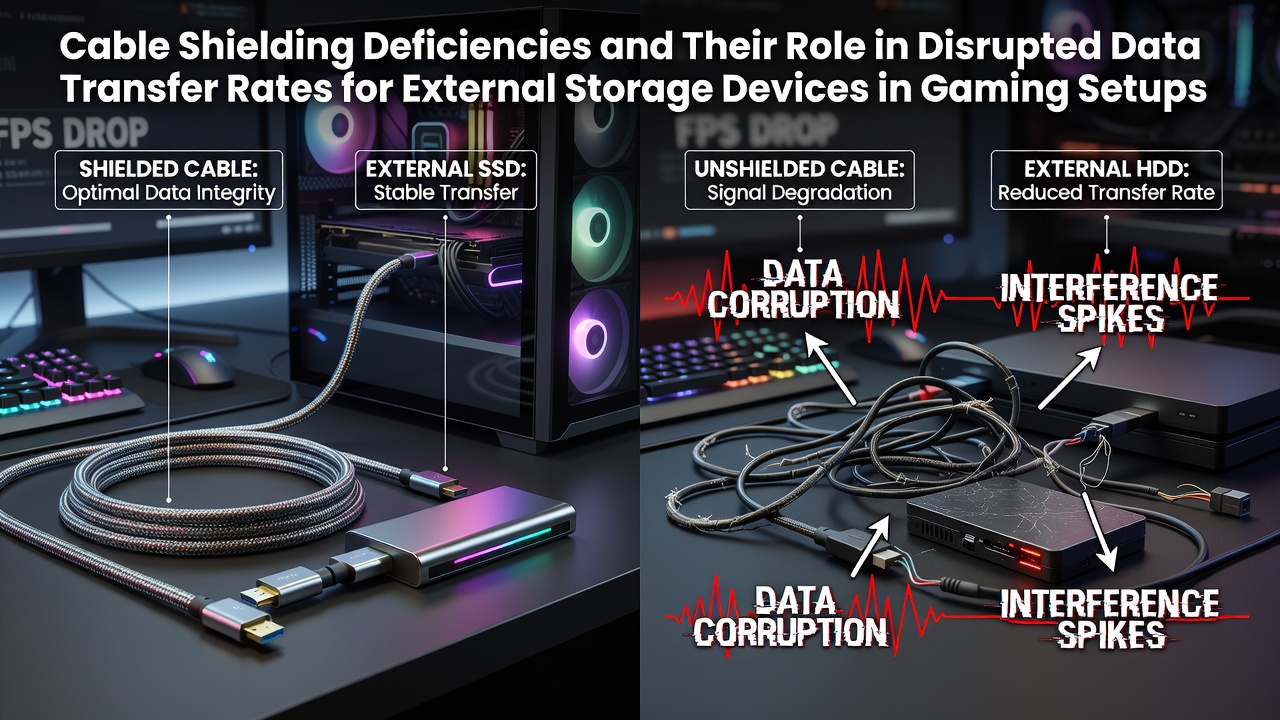
Cable Shielding Deficiencies and Their Role in Disrupting Data Transfer Rates for External Storage Devices in Gaming Setups
External storage devices connect to gaming systems through cables that rely on shielding layers to block electromagnetic interference, yet deficiencies in those layers allow noise to infiltrate signal paths and reduce effective data transfer rates during large file operations such as game installations or asset streaming. Research from multiple institutions shows that inadequate foil or braid coverage permits radio frequency emissions from nearby components including graphics cards and power supplies to couple into the data lines, resulting in retransmissions that lower sustained throughput below the rated specifications of USB 3.2 or Thunderbolt interfaces.
Understanding Shielding Construction in Data Cables
Manufacturers wrap conductors with combinations of aluminum foil and tinned copper braid to achieve target shielding effectiveness measured in decibels across frequency ranges from 30 MHz to 1 GHz, and when coverage gaps exceed 10 percent or braid density falls below 65 percent, attenuation drops sharply according to laboratory measurements published by standards organizations. Observers note that cost-reduced cables often substitute thinner foil or omit drain wires, creating vulnerabilities that become evident once the cable routes near high-current power lines or wireless transmitters common in desktop gaming environments.
Mechanisms of Interference in Gaming Configurations
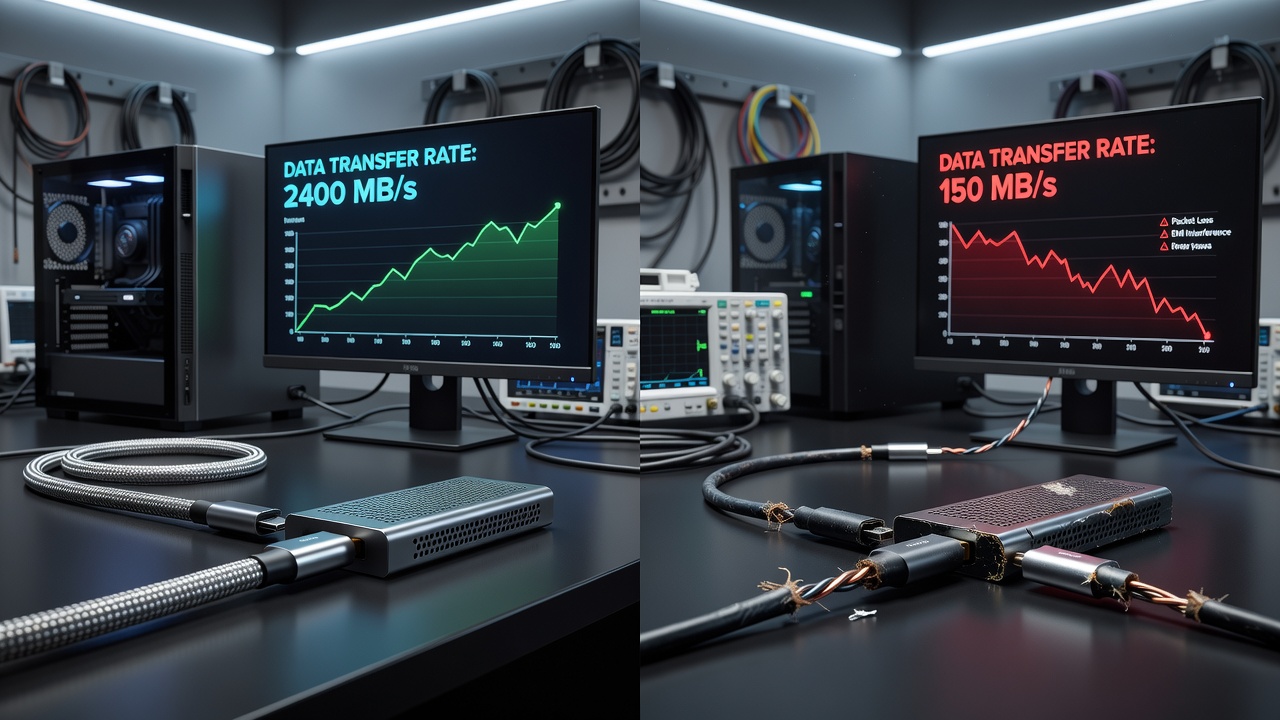
High-bandwidth external SSDs used for storing expansive game libraries experience packet errors when ambient electromagnetic fields induce voltages on unshielded segments, prompting the host controller to initiate error correction cycles that consume bandwidth and extend load times. Data indicates that transfer rates can fall from 800 MB/s to under 400 MB/s when shielding effectiveness declines by 20 dB, a condition documented in controlled tests involving multiple external enclosures placed adjacent to active graphics processing units. Those who've measured real-world setups report that USB hubs and extension cables compound the problem by introducing additional junctions where shield continuity breaks, allowing cumulative noise to accumulate along the signal path.
Observed Effects on Data Throughput and Latency
Studies conducted at technical universities across Europe reveal that external drives connected via substandard cables exhibit increased bit error rates during sustained reads of multi-gigabyte texture files, directly lengthening the time required for level streaming in open-world titles. Figures from the Australian Communications and Media Authority highlight that consumer-grade cables frequently fail to meet conducted emission limits established under CISPR 32, leading to measurable degradation once the drive operates near wireless peripherals or LED lighting controllers. In one documented configuration, swapping a compromised cable restored average transfer speeds to within 5 percent of the interface maximum, confirming that shielding integrity rather than the storage medium itself limited performance.
Common Sources of Shielding Degradation
Repeated flexing at connector strain reliefs fractures the braid over time, while manufacturing variances produce inconsistent foil overlap that leaves longitudinal slots for noise ingress, conditions that accelerate in portable drive enclosures subjected to frequent movement between gaming stations. Thermal cycling from prolonged gaming sessions expands and contracts cable materials at different rates, loosening shield terminations and reducing contact pressure at grounding points, which researchers at Canadian testing facilities have linked to progressive increases in radiated susceptibility above 300 MHz.
Measurement and Identification Approaches
Technicians employ spectrum analyzers and time-domain reflectometers to quantify shield transfer impedance and locate discontinuities without disassembling the cable assembly, methods that reveal whether performance shortfalls originate in the cable rather than the storage controller firmware or host chipset. Industry reports from the IEEE Standards Association indicate that cables passing basic continuity tests can still exhibit shielding effectiveness below 40 dB, sufficient to disrupt 10 Gbps links when external fields exceed typical residential levels near gaming hardware clusters.
Preventive Specifications and Replacement Criteria
Selecting cables certified to USB-IF or VESA standards ensures minimum braid coverage and foil integrity verified through production sampling, while periodic visual inspection for jacket damage or connector looseness allows users to replace units before throughput declines become noticeable during extended play sessions. Data from regulatory bodies in multiple regions shows that cables meeting enhanced shielding requirements reduce error-induced retransmissions by factors of three to five when installed in environments containing multiple high-speed digital devices.
Conclusion
Cable shielding deficiencies introduce a measurable variable into external storage performance within gaming setups, where sustained high-rate transfers expose limitations that remain hidden during lighter usage. Addressing shield continuity through specification compliance and timely replacement maintains the data rates required for seamless access to large game libraries stored on external media, supported by ongoing measurements from standards organizations and academic laboratories worldwide.